
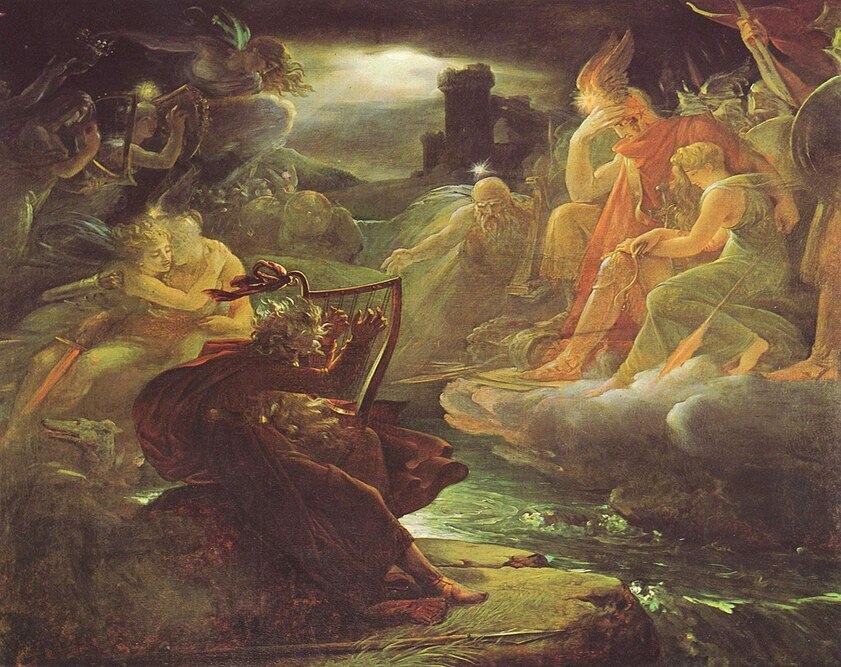
*This blog post was originally published in 2020 as an accompaniment to my journal article ‘Tolkien and the Age of Forgery: Improving Antiquarian Practices in Arda‘. It provides a biographic chronology of when the names and works of the eighteenth century forgers, Thomas Chatterton and James Macpherson, appeared in J.R.R. Tolkien’s own biography and works.
Content warning: their is a brief reference to suicide.
My article situated Tolkien’s legendarium as a literary descendent of the antiquarian projects from the ‘Age of Forgery’ in the 1760s. It argued that Tolkien’s motivation to create a national mythology echoed those of James Macpherson (1736-1796) and Thomas Chatterton (1752-1770). Drawing on previously unpublished folios from Tolkien’s undergraduate notebooks, it showcased his familiarity with the two forgers, their feigned literary heritages, and British antiquarian practices in the eighteenth century. It further argued that Tolkien improved on Macpherson’s and Chatterton’s antiquarian methodologies by marrying the oral tradition with the written word in The Book of Lost Tales, The Hobbit, and The Lord of the Rings.
Originally, the article was an extension of the second chapter from my Masters by Research thesis. In the thesis, I wrote an extensive ‘contextual survey’ of where and how Tolkien encountered Macpherson and Chatterton. Although enlightening, it did make the article 18,000 words! So here I am recreating it as a paratext to the original article – now I’m becoming antiquarian!
The year 1913 not only marked Tolkien’s introduction to the poetry of Francis Thompson (1859-1907) but also the eighteenth century literary forgers James Macpherson and Thomas Chatterton. Besides purchasing the three volumes of The Works of Francis Thompson across 1913 and 1914 during his student years at Exeter College, Oxford, he attended David Nichol Smith’s lecture series ‘Johnson and Friends’ in October 1913 which included a lecture on the ‘Age of Forgery’ of the 1760s on Wednesday 15th October (Hammond & Scull 2017b: 1292). What is enlightening is how Thompson was linked to Chatterton.
Although Thompson’s failed suicide attempt was not mentioned in the editions mentioned above, contemporary texts did explain how “the hand of Thomas Chatterton – reaching out to [Thompson] from the twilight world of poetry and of death – stayed his own hand” (Brégy 1912: 144). A vision of Chatterton supposedly appeared to Thompson in this moment of despair and stalled him. It was still believed in the early twentieth century that Chatterton had committed suicide and was a “fatal model for the Romantic, and later Pre-Raphaelite, poet” (Groom 2002: 12).1 Tolkien spoke about Thompson to the Exeter College Essay Club on 4th March 1914 and began with “biographical details” on Thompson’s life before proceeding to analyse his poetry (Hammond & Scull 2017a: 58). Thanks to Andrew Higgins, we can consult the transcript of Tolkien’s talk. Chatterton’s apparition is not mentioned, but this does not mean that Tolkien was not aware of the biographical detail (2015: 288–90).

Tolkien’s undergraduate notebooks suggest he was aware that calling Macpherson a fraud and forger was a popular move. Contemporary scholarship in Alfred Nutt and J.S. Smart (Smart being a source Tolkien noted in his notebook) ridiculed Macpherson’s work and Tolkien was exposed to The Poems of Ossian in Smith’s lecture on the publication’s most hostile critic, Samuel Johnson. So when Tolkien came to creating a typescript of his essay ‘The Kalevala’, it is of little surprise that he refers to Ossian in a derogatory way.
The dating of ‘The Kalevala’s’ typescript is problematic. Flieger consulted various Tolkien scholars and a conjectured range of dates appears to place its composition between 1919 and 1924 (Tolkien 2018: 64). It is only in the typescript, however, that the following appears:
The lateness of the date of the [The Kalevala] and publication is apt to make those with the (probably not entirely wholesome) modern thirst for the ‘authentically primitive’ doubt whether the wares are quite genuine. Read and doubt no more. Bogus archaism and the pseudo-primitive is as different from this as Ossian is from Middle Irish romance. (112)
Tolkien’s notes from Smith’s lecture on the ‘Age of Forgery’ shows that Tolkien was aware of Standish H. O’Grady’s Silva Gadelica (1892) which fell within the ‘Celtic Revival’ that sought to reclaim Ireland’s folkloric heritage. This included taking back the Irish heritage of Ossian, which Macpherson apparently stole. Tolkien’s notes imply that he saw Scottish lore as descendent in some way from Irish.2 The ‘bogus archaism’ in Ossian strengthens Tom Shippey’s point that Tolkien considered The Poems of Ossian to be nothing but “phony” (2007: 22). However, as I have argued elsewhere (building on Shippey’s work in Road to Middle-earth), Tolkien had a tendency to critically engage with texts that he considered “flawed”. The additional popularity of discrediting Macpherson around the turn of the twentieth century must have influenced these lines to some degree. The northern courage that the texts emulated must have also shown Tolkien that there was something desirable and reclaimable about The Poems of Ossian.
Macpherson and Chatterton would continue to come to Tolkien’s attention. The next encounter will have been after he returned to Oxford, this time as the Rawlinson and Bosworth Professor of Anglo-Saxon. Here he would meet C.S. Lewis, who became a Fellow and Tutor at Magdalen College, Oxford in 1925. Much later he briefly mentioned Macpherson and Chatterton in his ‘Addison’ chapter of James L. Clifford’s Eighteenth-Century English Literature (1959).
Lewis called their mythological projects objects of “wish-fulfilment” with a “sincere impulse” to “seek in the past that great romantic poetry” (Lewis 1959: 154–5). His reference to the Romantic movement links neatly back to the start of his career where he lectured on the eighteenth-century Romantics between 1926 and 1929. Lewis’s library included two annotated volumes of Chatterton’s works signed by his brother, Warren Lewis, and dated 8th November 1928 (Marion E. Wade Center 1986: 12).3 At this time Warren was serving in the British Expeditionary Force in Kowloon, China. He retired on 21st December 1932 and returned to England, but these dates come after Lewis’s lectures. It is therefore likely that Warren owned the two volumes initially and gave them to Lewis when he returned.
In his second term of employment Lewis commenced in presenting his first set of lectures on 23rd January 1926: “Some Eighteenth-Century Precursors of the Romantic Movement” (Heck 2019: 417). He would revise the lectures over the following two academic years: 6th May 1927 Trinity term saw the lecture series change to “Eighteenth-Century Romantics” (460), and on 23rd January 1929 to “The Eighteenth-Century Medievalists” (483).4
Contemporary scholarship gives us further reason to believe that the two writers featured. At the turn of the twentieth century, writers were deeply concerned with the origins and scope of British Romanticism. Works from Henry Beers and William Lyon Phelps placed Macpherson as a key precursor to the Romantic poets. William Courthope (a previous Oxford Professor of Poetry between 1895 and 1901) grouped Macpherson and Chatterton with various other eighteenth-century writers in ‘The Early Romantic Movement in English Poetry’ chapter of A History of English Poetry: Volume V (1905),4 classing Chatterton as a pseudo-medievalist (xxv), and calling the Rowley forgeries a “typical result of the Romantic Movement in English Poetry during the eighteenth century” (418). Chatterton’s interest in the Anglo-Saxons, his conjuring of the tenth century poet Turgot and his lasting impression on key Romantic poets (especially Keats) was further documented by biographies like E.H.W. Meyerstein’s A Life of Chatterton (1930). To Lewis, these will have signposted Macpherson and Chatterton’s integral connection to the Romantic period. They could not be ignored.5
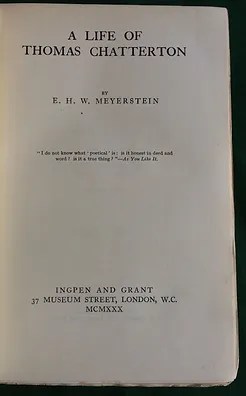
Meyerstein’s A Life of Thomas Chatterton will have sparked interest in Oxford as he had conducted some research for the book at the Bodleian, examining the original ‘Yeloue Rolle’ and ‘Songe of Ælla’ that the library held (1930: viii). It must have caught Lewis’s attention as well – thinking about the future of his ‘Eighteenth Century Medievalists’ lecture series. There are, however, no recordings of Meyerstein ever meeting Lewis or Tolkien.
It should be further clarified at this moment that the Magdalen archives provide no evidence that Meyerstein was a Fellow at the College during his life, he was never offered any position after completing his degree.6 The only other tie that connects Meyerstein to Tolkien is the publication of their poems in the Oxford Poetry anthologies during their overlapping student years. Tolkien published ‘Goblin Feet’ in the 1915 collection whereas Meyerstein saw his poetry appear in volumes from 1910 through to 1917. It is possible therefore that Tolkien read some of his poetry during his time as a student and was aware of the name.
After Tolkien and Lewis first met on 11th May 1926 during an English Faculty meeting at Merton College, they continued to bond over their shared love of Norse Mythology in Lewis’s office (Carpenter 2002: 192–4). Although this was initially their key motive, there is no doubt that they discussed other literary works and Tolkien later recalled Lewis’s remark: “’Tollers, there is too little of what we really like in stories. I am afraid we shall have to try and write some ourselves’” (2006: 378). They ‘really liked’ myth and in their discussions on the mechanics of myth-building Lewis’s knowledge of Macpherson and Chatterton will have come in handy. During Inkling meetings, a group of “practicing poets” (Tolkien 2006: 36), Tolkien would present extracts from The Lord of the Rings as it was being written. It is possible that the Inklings explored the topic of mythic forgery as a response to the mythic scope of Tolkien’s Middle-earth. Lewis could have then easily interjected the names Macpherson, Chatterton, and the ‘Age of Forgery’.
The early twentieth century saw a rapid increase in Oxford’s interest in the Romantic poet John Keats, a figure that helped to popularise Chatterton through his explicit and implicit dedications and references. Significantly, Oxford scholars had started to tie Keats back to Chatterton. In Colvin (albeit not an Oxford employee but the author of the Keats (1887) biography that Tolkien borrowed in 1915), Tolkien will have read how “the archaic jargon concocted by [Chatterton came from] Kersey’s Dictionary” (1909: 53), but not how Keats tried to emulate the style in ‘The Eve of St. Mark’. Colvin’s brief nod to Keats’s letters laid the path for Ernest de Sélincourt, who held the position of Oxford Professor of Poetry between 1928 and 1933 and sat in meetings with Tolkien. In his introduction to his 1905 edition of Keats’s poems, Sélincourt identified Keats’s admiration for the Rowley dialect as the origin of the “unfortunate attempt, in [‘The Eve of St. Mark’], to reproduce the actual language of the Middle Ages”, locating the occasional similarity of cadence to those in ‘Excellent Ballad of Charitie’ (Keats 1905: lv).
Building on Sélincourt, W.J. Courthope (Oxford Professor of Poetry between 1895 and 1900) would saw both poets as sharing a common motive, giving reason for Chatterton to be the “most English of poets” to Keats: “both of them sought to create an ideal atmosphere for poetry by reviving old words and arranging them in metres and rhythms far removed from the idioms of living speech” (Courthope 1910: 339). Although Keats perhaps did not understood how Chatterton constructed Rowleyese, it was evident at the time that he was not shy in experimenting with a medieval-style on a medieval-themed poem. It had therefore been established that ‘The Eve of St. Mark’ (1819), alongside ‘The Eve of St. Agnes’ (1819), ‘Isabella or the Pot of Basil’ (1819) and ‘La Belle Dame sans Merci’ (1819), were all medieval- themed poems.
The publication of Dante Gabriel Rossetti’s letters on Keats in 1919 further confirmed this (John Keats: Criticism and Comment). Although Rossetti did not reference Chatterton, he considered ‘The Eve of St. Mark’ to show “astonishingly real mediævalism for one not bred as an artist” and it cannot be overlooked that Rossetti, like Keats, wrote a poem on Chatterton in 1881 (1919: 9). His brother, William Michael Rossetti, had previously noted in his Life of John Keats that Keats’s poetry “testifies” his “admiration” for Chatterton (1887: 67). The connection would not have gone unnoticed.
The Chatterton Keats criticism finally led to Meyerstein, who paid even closer attention to Chatterton’s influence on Endymion (1818) and other pieces. It was suggested to Meyerstein that “Endymion may stand for Keats himself, Glaucus for Rowley-Chatterton, and their task for the deliverance of English Poetry from the death-like bondage of the eighteenth century” (1930: 511). His interpretation has the slight echo of nationalism that had permeated England in the first few decades of the twentieth century. The statement also reflects Tolkien’s own work in The Book of Lost Tales but instead of just the eighteenth century, Tolkien wished to upturn the English literary tradition that had been accumulating since Edmund Spenser. If Tolkien did read Meyerstein’s book, he will have been unconsciously absorbing the culmination of over thirty years of scholarly work on Chatterton and Keats.
In 1939, Tolkien would deliver his ‘On Fairy-stories’ lecture at the University of St. Andrews. As Verlyn Flieger and Doug. A. Anderson have identified, Tolkien owned all four volumes of J.F. Campbell’s Popular Tales of The West Highlands (1890–1893 editions) and referenced them in his lecture (Tolkien 2014: 98). Campbell sought to locate some of Macpherson’s sources and celebrated The Poems of Ossian as part of Scotland and the wider Celtic heritage. If Tolkien read the fourth volume, which maps out the Ossian controversy, he will have been presented with a very different viewpoint to that of Nutt and Smart. Campbell compiled a vast list of poems and ballads that held the ‘the germ of Ossian’ and presented the argument that “anything which has ever been extensively known amongst the Scotch Gael has been equally well known to their Irish brethren” (1893: 131). He concluded the fourth volume by ranking The Poems of Ossian with Alfred, Lord Tennyson’s Idylls of the King (1859–1885) and Homer, noting how the latter and The Poems of Ossian both draw on “floating ballads” and “genuine materials” (228).
Tolkien would later take over the supervision of Thomas J. A. Monaghan’s thesis on “Thomas Tyrwhitt (1730-1786) and his contribution to English Scholarship” from Smith in 1945 to its completion in 1947 (Cilli 2019: 350; Hammond & Scull 2017a: 314). Within the history of English scholarship, his editorial edition of Chatterton’s works in 1778 was the first collected publication of Chatterton’s Rowley works and will have naturally been covered. The Tyrwhitt edition was significant in the development of the Rowley controversy as the full title proved his scepticism:
Poems, supposed to have been written at Bristol, by Thomas
Rowley, and Others, in the Fifteenth Century. To which is added
an Appendix, containing some observations upon the Language
of these Poems; tending to prove, that they were written, not by
any ancient author, but entirely by Thomas Chatterton. (1778)
If Tolkien looked into the edition he will have read about Chatterton’s efforts to provide Bristol with a deeper history. Tyrwhitt quoted George Catcott, who identified the “Account of the ceremonies observed at the opening of the old bridge” as being Chatterton’s emergence into print (Chatterton 1778: vi–vii). Chatterton wrote this shortly after the opening of the new bridge between Bristol and Redcliffe and it will have proved how he wished to “bring the past alive” (Haywood 1986: 144), a notion Tolkien had been invested in for just over thirty years. This will have been enhanced over the page where Tyrwhitt draws attention to the descriptions of ‘Ethelgar’ and ‘Cerdick’. They were “translated from the Saxon” with numerous appendages such as “Observations upon Saxon heraldry” and “Saxon achievements” (Chatterton 1778: viii). These will have illustrated to Tolkien how the intention behind The Book of Lost Tales and his rapidly increasing interest in designing documents from Middle-earth followed very closely in Chatterton’s footsteps.
The next mention comes in 1950. Here Tolkien was appointed to supervise G. M. G. Evans’s B. Litt Middle English subject, which was Thomas Chatterton (Hammond & Scull 2017a: 390). Hammond and Scull’s Chronology shows that Tolkien continued to supervise Evans during their years at Oxford.
A variety of editions will have been available to Evans and Tolkien from the Bodleian Library. Henry D. Roberts’s 1906 two volume edition of The Complete Poetical Works of Thomas Chatterton was the first “complete collection of the poems” since Skeat’s controversial edition (Chatterton 1906: ix). However, he followed in Skeat’s footsteps by “retaining the spirit and as much as possible of the original words” but removing all the archaic spellings (xi):
O Christ, it is a grief for me to tell
How many a noble earl and valourous knight
In fighting for King Harold nobly fell,
All slain in Hastings field in bloody fight.
(Chatterton 1872: 134).8
Sidney Lee did the same with the two volume The Poems of Thomas Chatterton (1906). Maurice Evan Hare later edited The Rowley Poems by Thomas Chatterton in 1911, reprinting the texts from Tyrwhitt’s 1778 edition and keeping the original spellings. Tolkien will have most likely recommended Tyrwhitt’s edition that he had most likely examined with Monaghan in the 1940s.
However, he could have additionally consulted Skeat’s edition as a modern reaction to Chatterton’s Rowleyese. Although Skeat modernised the language of Chatterton’s work and removed the archaic language that gave it its medieval-sounding aesthetic, Tolkien was very familiar with Skeat’s name and significant philological work as he was awarded the Skeat Prize in 1914 and had borrowed his editions of Chaucer many times as a student and professor (Cilli 2019: 47–52). Therefore it is possible that Tolkien was aware of Skeat’s editions of Chatterton for their philological approach.
Skeat had provided a detailed linguistic breakdown of Chatterton’s ‘Rowleyese’ (the language Chatterton generated for his Rowley poems) which must have piqued Tolkien’s interest. Additionally, Edward Bell’s ‘The Life of Thomas Chatterton’ that introduced the first volume identified ‘Ethelgar’ and ‘Kendrick’ as being “obviously written in imitation of Ossian” (Bell 1872: xxvi), and the inclusion of Chatterton’s letters revealed that “the pieces called Saxon are originally and totally the production of my muse; though I should think it a greater merit to be able to translate Saxon” (Chatterton 1872: 333). Such a point will have reiterated to Tolkien that Chatterton’s work was “deeply rooted in Anglo-Saxon, Anglo-Norman, and English history” as he “addressed events that were either significant in the development of his native Bristol or crucial in defining the modern English nation” (Bristow & Mitchell 2015: 10). He and Chatterton shared a passion for resurrecting what they believed was the lost Anglo-Saxon culture and history.
The final known reference comes in a letter from Hugh Brogan in December 1954. In it, Brogan describes parts of The Two Towers, especially ‘The King of the Golden Hall’ chapter, as ‘“Ossianic”’ (quoted in Tolkien 2006: 225). Tolkien does not directly reference Ossian or Ossianic in his reply, but does return to a similar point he had made previously in his typescript to ‘The Kalevala’ essay. Comments such as “the proper use of ‘tushery’ is to apply it to the kind of bogus ‘medieval’ stuff which attempts (without knowledge) to give a supposed temporal colour with expletives” and “learn to discriminate between the bogus and genuine antique” recall ‘The Kalevala’ essay because of the word “bogus”, which he had previously used to describe Ossian (Tolkien 2006: 225–6). Although this would superficially suggest that he was not fond of The Poems of Ossian, he could have absorbed aspects of Macpherson’s work with the intention of stylistically improving it.
Additionally, Tolkien used his letters to control the public’s view of him. He was very clear which authors and texts had influenced him in his writing process. However, his letters also show him contradicting himself. In a drafted response to Robert Murray, S.J., Tolkien recollects how there are “always defects in any large-scale work of art; and especially in those of literary form that are founded on an earlier matter which is put to new uses – like Homer, or Beowulf, or Virgil, or Greek or Shakespearean tragedy! In which class, as a class not as a competitor, The Lord of the Rings really falls” (Tolkien 2006: 201). His summary perfectly suits The Poems of Ossian and as Murry’s letter came shortly before Brogan’s “‘Ossianic’” comment, it is possible that Tolkien thought about Macpherson as he was writing this paragraph.
Tolkien’s consistent exposure to these writers meant that they could have been on his mind while he was working on his legendarium and The Lord of the Rings. As I showed in my article ‘Tolkien and the Age of Forgery’, Macpherson’s and Chatterton’s presence is certainly felt in the legendarium from its early conception to its more mature versions. Tolkien may have used letters and other methods of public engagement to distance himself from the Age of Forgery but his academic life evidences that he came back again and again to Macpherson and Chatterton.
Notes
- See Clark (1906, p. 258). ↩︎
- Thanks to John D. Rateliff for this insight. ↩︎
- Chatterton, T. (1842). The Poetical Works Of Thomas Chatterton: With Notices Of His Life, History Of The Rowley Controversy. A Selection Of His Letters, And Notes Critical And explanatory. [Ed. Willcox. C. B.]. Cambridge: Metcalfe and Palmer. This information comes from personal correspondence with Laura Schmidt from The Marion E. Wade Center, Wheaton College. ↩︎
- The change from ‘Romantics’ to ‘Medievalists’ could possibly be down to Tolkien’s influence. Dimitra Fimi and Andrew Higgins note how ‘by 1927, Tolkien had got Lewis involved in his newly formed informal club to read Old Norse sagas in their original’, suggesting that Lewis’s perception on the scope of his lectures may have changed (quoted in Tolkien, 2016, p. xxxvii). ↩︎
- It is curious to note that Courthope’s volumes are noted as ‘useful’ by Tolkien during his work in Oxford (quoted in Cilli, 2019, p. 62). ↩︎
- Meyerstein would draw on and evaluate these references in A Life of Chatterton, examining Chatterton’s influence on Coleridge, Blake, Wordsworth, Shelley and Byron. ↩︎
- This information comes from personal correspondence with Dr Charlotte Berry from Magdalen College. ↩︎
- See the original spelling of these lines (from Tyrwhitt’s 1778 edition) on page 106. ↩︎
Bibliography
Bell, E. (1872). ‘The Life of Thomas Chatterton’. In Walter Skeat. (Ed.), The Poetical Works of Thomas Chatterton Volume I. (pp. xiii – cvii). London: Bell and Daldy.
Brégy, K. (1912). The Poets’ Chantry. London: Simpkin, Marshall, Hamilton, Kent & Co. LTD.
Bristow, J. & R. N. Mitchell. (2015). Oscar Wilde’s Chatterton: Literary History, Romanticism, and the Art of Forgery. New Haven: Yale University Press.
Campbell, J. F. (1893). Popular Tales of The West Highlands: Volume IV. Postscript. London: Alexander Gardner.
Carpenter, H. (2002). J.R.R. Tolkien: A Biography. London: HarperCollins.
Chatterton, T. (1778). Poems, Supposed to have been Written at Bristol by Thomas Rowley, and Others, in the Fifteenth Century. [Ed. Tyrwhitt, T.]. London: T. Payne and Son.
Chatterton, T. (1872). The Poetical Works of Thomas Chatterton Volume I. [Ed. Skeat, W, W.]. London: Bell and Daldy.
Chatterton, T. (1906). The Complete Poetical Works of Thomas Chatterton. [Ed. Roberts, H. D.]. London: George Routledge and Sons.
Cilli, O. (2019). Tolkien’s Library: An Annotated Checklist. Edinburgh: Luna Press Publishing.
Colvin, S. (1909). Keats. London: Macmillan and Co.
Courthope, W. J. (1905). A History of English Poetry: Volume V. London: Macmillan and Co., Limited.
Courthope, W. J. (1910). A History of English Poetry: Volume VI. London: Macmillan and Co., Limited.
Groom, N. (2002). The Forger’s Shadow. London: Picador.
Haywood, I. (1986). The Making of History. London: Associated University Presses.
Heck. J. (2019). Chronologically Lewis. Available at: http://www.joelheck.com/resources/Chronologically%20Lewis%20February%2014%202019.pdf
Higgins, A. (2015). The Genesis of J.R.R. Tolkien’s Mythology. PhD. Cardiff: Cardiff Metropolitan University.
Keats, J. (1905). The Poems of John Keats. [Ed. Selincourt, E. D.]. New York: Dodd, Mead & Company.
Lewis, C. S. (1959). ‘Addison’. In James L. Clifford (Ed.), Eighteenth-Century English
Literature. (pp. 144 – 157). Oxford: Oxford University Press.
Marion E. Wade Center. (1986). C. S. Lewis Library. Available at: https://www.wheaton.edu/media/wade-center/files/collections/author-library-listings/Lewis_Public_shelf_OFF-SITE-LIST_20190410.pdf
Meyerstein. E. H. W. (1930). A Life of Chatterton. London: Ingpen and Grant.
Rossetti, G. D. (1919). John Keats: Criticism and Comment. Letters (privately printed) to H. B. Forman. London.
Hammond, W. G. & Scull, C. (2017a). The J.R.R. Tolkien Companion: Chronology. New York: Houghton Mifflin Press.
Hammond, W. G. Scull, C. (2017b). The J.R.R. Tolkien Companion: Reader’s Guide Part II. New York: Houghton Mifflin Press.
Shippey, T. (2007). Roots and Branches: Selected Papers on Tolkien. Zurich: Walking Tree Publications.
Tolkien, J. R. R. (2006). The Letters of J.R.R. Tolkien. [Ed. Carpenter, H. with the assistance of Tolkien, C.]. London: HarperCollins.
Tolkien, J. R. R. (2014). Tolkien On Fairy-stories. [Ed. Flieger, V. & Anderson, D. A.]. London: HarperCollins.
Tolkien, J. R. R. (2018). The Story of Kullervo. [Ed. Flieger, V.]. London: HarperCollins.

 Will Sherwood
Leave a comment