

During a recent flight I had the opportunity to reacquaint myself with Alex Garland’s Ex Machina (2015). What struck me within the opening minutes was how the film sets itself up to explore Romantic-period ideas on authorship and genius. There is a Frankensteinesque quality to the author and creation but here but instead of a father-son relationship, it’s a father-daughter model. In this blog post I want to examine how the film critiques the genius Romantic author model. Spoilers ahead.
In my first series of blog posts I considered how the Victorians created what we think of as Romanticism in the twenty-first century. In this new series, I’m interested in delving into examples of twentieth and twenty-first century renderings of Romantic ideas across a range of media: literature, film, art, music etc. (yes, metal music will return). A part of this is to turn away from the idea of a ‘legacy’ (which is used as the title of several books on Romanticism in the c19-21) with its connotations of afterlife and generational inheritance. Instead, I want to think about Romanticism as transformative: ‘Romantic transformations’ implies an ongoing conversation that we are still having with Romanticism, something that is still dynamic and alive rather than static and fossilised. In this sense, I want to move away from a fixed (new) historical approach to the Romantic period and Romanticism and open up discussion about Romanticism as an ingrained part of our day-to-day culture in the twentieth and twenty-first century. I hope that through exploring this shift I’m able to think a little more critically about the benefits (and possible problems) it poses.
The Genius Romantic Author Model
Towards the end of the eighteenth century in Britain a new model of the author was emerging that would take root in Western thought and culture. Through their writing, poets such as William Wordsworth, Samuel Taylor Coleridge, and Percy Bysshe Shelley built and bought into a vision of the poet/author as unique, gifted, inspired, and genius individuals who stood outside of and above society. The author figure was innately superior to the rest of humanity because of their creative imagination and ability to perceive and communicate complex, divine, universal truths to their readers. These authors commonly framed themselves as solitary, wandering geniuses and it was their alienation that reinforced their illusory specialness and contributed towards the originality of their art.
As Andrew Bennett summarises: “the Romantic author is ultimately seen as different from humanity itself. He is seen as both an exemplary human and somehow above or beyond the human, as literally and figuratively outstanding. He is, after all, ahead of his time, avant-garde. The idea of the Romantic author […] is conceived as a subject inspired by forces outside himself, forces that allow him to produce work of originality and genius” (2005: 60; italics original, bold mine). Of note here is Bennett’s use of masculine pronouns (he, himself, him). This particular image of the genius Romantic author was wrapped up in a joint vision of superiority and patriarchy as David Higgins soberly reminds us (2005: 6).
To hear how this authorial model sounded in the Romantic period, it is worth turning to a key, canonised text: Wordsworth’s ‘Preface’ to the second edition of the Lyrical Ballads (1800) (co-written with Coleridge). The following passage is quoted in full. I have put in bold phrases that link to the genius Romantic author model:
Taking up the subject, then, upon general grounds, let me ask, what is meant by the word Poet? What is a Poet? to whom does he address himself? and what language is to be expected from him?—He is a man speaking to men: a man, it is true, endowed with more lively sensibility, more enthusiasm and tenderness, who has a greater knowledge of human nature, and a more comprehensive soul, than are supposed to be common among mankind; a man pleased with his own passions and volitions, and who rejoices more than other men in the spirit of life that is in him; delighting to contemplate similar volitions and passions as manifested in the goings-on of the Universe, and habitually impelled to create them where he does not find them. To these qualities he has added a disposition to be affected more than other men by absent things as if they were present; an ability of conjuring up in himself passions, which are indeed far from being the same as those produced by real events, yet (especially in those parts of the general sympathy which are pleasing and delightful) do more nearly resemble the passions produced by real events, than anything which, from the motions of their own minds merely, other men are accustomed to feel in themselves:— whence, and from practice, he has acquired a greater readiness and power in expressing what he thinks and feels, and especially those thoughts and feelings which, by his own choice, or from the structure of his own mind, arise in him without immediate external excitement.
(Wordsworth 2013: 103-4)
Wordsworth repeatedly emphasises the poet as an advanced being. They are better at empathising with others and are more sensitive (sensually, mentally, and emotionally) to their surroundings. Wordsworth’s reputation throughout the nineteenth and twentieth centuries as the core of Romanticism keeps this particular notion of authorship alive in Western thought and culture. Even in the twenty-first century secondary-school English classroom, (pre-)teenagers cannot escape Wordsworth’s poetry and we often frame artists, musicians, actors, and directors as singular geniuses. Consider. For example, consider how I opened by categorising Ex Machina as Alex Garland’s film; reducing the film to simply its director overlooks the staggering community that worked on the film. But I digress.
If you have seen Ex Machina hopefully you are already starting to connect several key words with Oscar Isaac’s character, Nathan.
Ex Machina Plot Summary
A quick summary may be a good idea at this point. Certain words are in bold as a nod to the last section. In essence, Caleb ‘wins’ a competition at work and is flown into the wilderness to meet with the company’s reclusive ‘boss‘, Nathan. The rest of the film plays out at Nathan’s isolated home. Nathan reveals to Caleb that he has created Artificial Intelligence (AI) and that Nathan will be the human component in a Turing Test. Caleb meets Ava – Nathan’s AI. A curious note here is that Caleb only ever meets Ava with a glass wall between them: Ava is imprisoned, contained by her ‘dad‘ (Nathan literally likens himself in this way: “I’m like her dad, right?”). Over the course of the film, Caleb’s confidence in what Nathan tells him wavers; his loyalties are tested, and it is clear that a part of the reason for this is that he has developed feelings for Ava. This is partially influenced by Nathan’s alcoholism, his problematic treatment of his ‘children‘ (Ava wasn’t the first AI and isn’t the only one in his home), and the realisation that in order to give Ava the greatest insight into human behaviour Nathan hacked the data from his search engine, ‘Blue Book’, and every single mobile device in the world and downloaded everything into Ava.
Nathan’s and Caleb’s conversations probe deeper into the motivations and triggers for Ava’s actions: does Ava truly like Caleb back or is she consciously ‘performing’ human gestures to seduce him? For Nathan, Caleb’s behaviour plays into why he really flew Caleb into the middle of wild. The Turing Test was simply a cover for Nathan to test Ava’s ability to manipulate Caleb into freeing her. But even Nathan underestimates Caleb; Ava escapes, killing Nathan and trapping Caleb. She boards the helicopter and leaves for an American metropolis. Ava (creation/art/child) lives while Nathan (author/father) dies.
Mozart and Art
From early on Ex Machina establishes that Nathan was a child prodigy. In Caleb’s second meeting with Ava he explains that “Nathan wrote the Blue Book base code when he was 13. […] what he did was like Mozart or something.” Nathan’s author status is confirmed by him ‘writing’ code, an action intimately associated with authorship. Mozart’s iconic cultural status as the musical prodigy betrays how Caleb idolises Nathan as the coding prodigy with whom no one in the industry can ever compete. Trailing off with “something” further leans into Caleb’s othering of Nathan because of his perceived novelty.
But there’s a subtle piece of foreshadowing in this allusion. While Wolfgang Amadeus Mozart is classified as a Classical- rather than a Romantic- period composer, his early death at the age of 35 prefigures and probably helped to inform the myth of the Romantic author who burns themself out too early: Thomas Chatterton (17), John Keats (25), Percy Bysshe Shelley (30), Lord Byron (36). As I mentioned in the plot summary above, Nathan joins this host of young authorial geniuses who succumb to their work – think of the romanticising of Mozart in Amadeus (1984) when he literally dies from exhaustion while writing his Requiem in D minor, K. 626. But Ex Machina literalises this myth when Nathan is stabbed to death by his own creation/daughter. As I also noted above, Nathan’s behaviour towards his creations/children raises ethical questions about the genius Romantic author model. Nathan abuses Ava and another AI, Kyoko, in multiple ways and his death at the hands of his abused creations/children forms a fitting poetic end to his arc.
Speaking of poetic. Thus far I’ve been referring to Nathan as an ‘author’ and Ava as his ‘creation’. But what would happen if we shifted our perspective and consider Ava as a work of ‘art‘ in a Romantic sense? Matthew Sangster has reflected how one of the “unfortunate legacies of artistic Romanticism is the lingering idea that true art is made by unique geniuses who channel something that has never previously existed into the world” (2023: 105; bold mine). Sangster highlights how this impression is “self-evidently contradictory” as novel art “does not “arise fully formed from the ether, rather, [it] build[s] on previous achievements” and this in turn prompts the question how ‘innovative’ Nathan thinks Ava is (ibid. 106; bold mine).
Nathan explains to Caleb that Ava’s mind is formed by “structured gel”, a substance that can “arrange and rearrange [itself] on a molecular level”, allowing it to “hold […] for memories” and “shift […] for thoughts”. In opposition to the restrictive and insular “circuitry” and “hardware” of social media technology, Nathan desired something fluid and malleable, to grant freedom for creativity and ingenuity on Ava’s part: “wetware”. The software, as I explained above, comes from an amalgamation of data from Blue Book and every phone on the planet – it is, therefore, not ‘original’. But Nathan believes that his revelation is as it delves deeper than his money-driven competitors. For Nathan, search engines aren’t a “map of what people [are] thinking”, rather, they are a “map of how people are thinking … Impulse … Response …. Fluid … Imperfect … Patterned … Chaotic” (bold mine).

To Nathan this shift to a metacognitive framework for Ava’s mind offers a far more advanced insight into the complexity of consciousness. He believes he has stumbled onto something that has “never previously existed into the world”; the “wetware” and metacognitive framework of Ava’s mind is truly innovative and to Nathan’s mind far surpasses the achievements, or even the capabilities, of his peers. This is reinforced when Nathan contrasts Ava to Jackson Pollock’s No. 5, 1948 (1948) (below). Instead of Ava acting like she has been programmed (automatic AKA ‘automated’ action), Nathan is searching for something deeper that symbolises the evolution of her consciousness: the “challenge is not to act automatically. It’s to find an action that is not automatic from painting, to breathing, to talking, to fucking, to falling in love.” This goes back to how he desires to see Ava acting impulsively, fluidly, imperfectly, and chaotically to formulate her own impressions of and reactions to the world around her. Playing into the ideology of Romantic art, Nathan’s ‘art’ shouldn’t be what he calls a “simulation” or impression, Ava as art should be natural, authentic, “actual”. Nathan deifies himself as a visionary who is singularly responsible for the “greatest scientific event in the history of man”, in a Romantic sense Ava is consequently framed as superior, actual art.

The Reclusive God
How Nathan frames himself is also impacted by Caleb. Between their first and second conversation, the following metaphor develops:
Nathan “if [the Turing Test] is passed, you are dead center of the greatest scientific event in the history of man”
Caleb “If you’ve created a conscious machine, it’s not the history of man. That’s the history of gods.”[…]
Nathan “I wrote down that other line you came up with. The one about how if I’ve invented a machine with consciousness, I’m not a man, I’m God.”
Caleb “I don’t think that’s exactly – “
Nathan “I just thought, ‘Fuck, man! That is so good… When we get to tell the story. You know? I turned to Caleb, and he looked up at me and he said ‘You’re not a man, you’re God.”
Caleb “Yeah, but I didn’t say that.”
At face value Caleb’s initial rejection that Nathan is human is implicit. He isn’t explicitly talking directly about Nathan himself. However, he is clearly romanticising Nathan’s achievements, deifying him as meta to what is humanly possible. This is visually reinforced by Nathan standing over Caleb, the latter sitting in a chair and literally looking up at the former. This is later recalled and weaved into Nathan’s own retelling to reinforce his own egotistical, godly illusion. Positioning Caleb as a kind of acolyte who reveres Nathan implies that Nathan wishes to appear humble in the “story” they “get to tell”. Underpinning this is the blasphemous assumption that Nathan is “God”. The determine “a” is not present. There is no plurality in ‘I’m a God’, ‘You’re a God.” This alters Caleb’s original “history of Gods” which he objects to twice. The story Nathan writes for posterity’s sake is that Caleb, and hopefully the rest of humanity, think of him as the One God who paved the way for the future of consciousness.
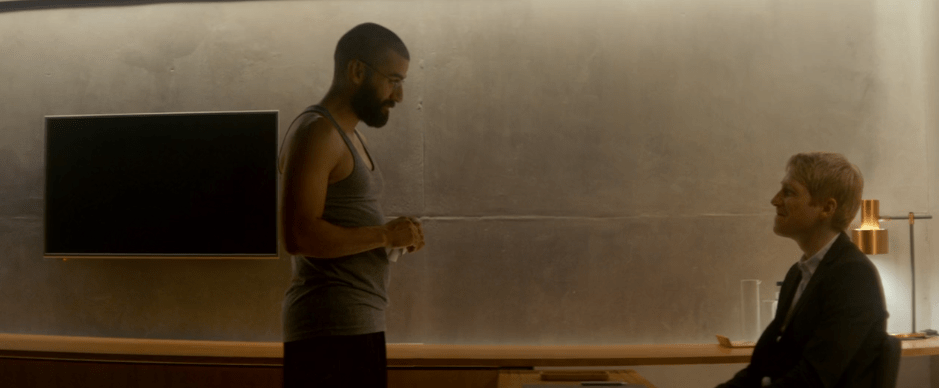
However, Nathan’s delusion of godly grandeur, with its connotations of omnipotence and omniscience, is what directly causes his downfall. The film offers a critique of the inherent egoism of the genius Romantic author model by turning its idealised strengths into its hamartia. Nathan’s belief that he is the Father and architect of the experiment, that he has dominion over Ava and Kyoto, and control over Caleb is precisely why he underestimates Caleb. Nathan’s and the audience’s shared revelation that Caleb has disabled the power to the home the night before Nathan confronts him, believing he has undermined Caleb’s plan, is shocking because the audience buys into Nathan being the all-knowing/powerful patriarch. In its critique of the genius Romantic author model, then, Ex Machina provides a broader study and criticism of social isolation and social hierarchy.
This becomes a little more apparent in the scene when both men hike up the mountain to the edge of the glacier – an act common for Romantic-period authors that led to revelations of the self and its relation to the world. I think the setting is pivotal here. It is notable that the only time the two men are talking outside of Nathan’s home is in this scene, high up in the mountains, gazing at a glacier that extends up and out of the frame, symbolising natural power. It is here Nathan implies that he believes genius and intellect to be gifts, that he and Caleb are powerful because their innate potential places them far above their peers. The glacier could be read as standing in for their untapped potential.

In retort to Caleb’s challenge that he wasn’t a ‘lucky winner’ of a company competition, Nathan reflects “you don’t think I know what it’s like to be smart? Smarter than everyone else, jockeying for a position. You got the light on you, man. Not lucky… chosen” (bold mine). Nathan’s attempt to build solidarity with Caleb strengthens the impression that he sees himself as simply better than the rest of humanity. While he is referring to the faux competition, his closing line “Not lucky… chosen” has broader implications that Nathan thinks they are meant to be recluses, their “programming” means they do not fit into society or culture like everyone else. Their isolation is perhaps the condition for their genius and ability to pave the way for the “history of Gods.” However, such a mindset also opens the door for Nathan believing his gift gives him the authority to act and behave as he sees fit. To him the ethics of his behaviour aren’t problematic because he is above and beyond such socio-cultural structures. Consent, misogyny, and racism to name just a few do not direct or impact his thinking when he engages with Ava or Kyoko. Again, it is this worldview that paves the way for his death. The scene aptly concludes with Nathan walking away from Caleb, supposedly leaving him, in an act of solitude.
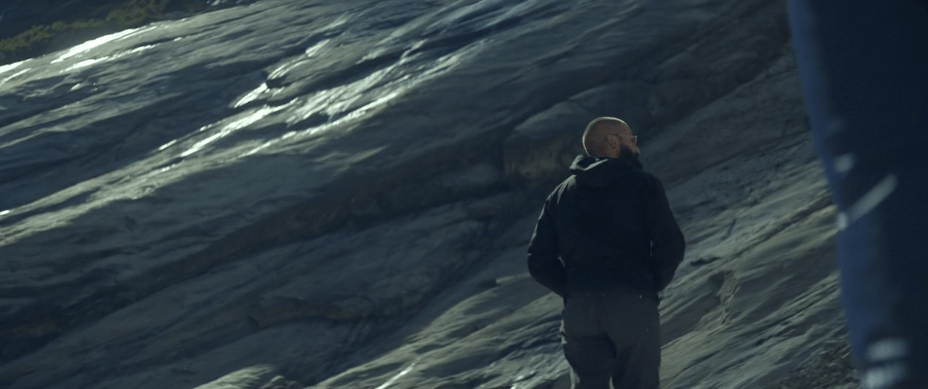
The setting reminds us just how remote and removed Nathan is and the impact this has had on his worldview and his relationship with the world. His extreme behaviour (alcoholism, plethora of abuse etc.) goes unchecked and Ava’s escape is ultimately down to a failure in communication and collaboration between Nathan and Caleb. The perils of isolation are thus played out in Nathan and his demise.
Nathan’s self-imposed isolation materialises the idea of the genius Romantic author as a reclusive figure and the film’s denouement offers a graphic critique of the dangers posed by authorial isolation and delusions of godly grandeur. To take this reading one step further and to wrap up this first blog post in my ‘Romantic Transformations’ series, Nathan’s death can be understood as an allegorical concretising of the death of the genius Romantic author. More could be said on the conscious parallels between Nathan and Victor Frankenstein and Ava and the Creature. The authorial model explored in this blog post is precisely what Mary Shelley was critiquing in Frankenstein (1818), providing Victorian and later authors with a template to explore the reclusive genius scientist (Strange Case of Dr Jekyll and Mr Hyde (1886), The Island of Doctor Moreau (1896) etc.). But while Frankenstein dies during his pursuit of his ‘son’, Nathan is murdered by his ‘daughter’. Ex Machina thus pushes beyond previous iterations in a rather Romantic manner reminiscent of Shelley’s Ozymandias (1818) to remind us that our creations, our art: AI, will always outlive us.
Bibliography
Bennett, Andrew. 2008. The Author: The New Critical Idiom (New York: Routledge).
Garland, Alex. dir. 2014. Ex Machina.
Higgins, David. 2005. Romantic Genius and the Literary Magazine: Biography, Celebrity and Politics (Abingdon: Routledge).
Sangster, Matthew. 2023. An Introduction to Fantasy (Cambridge: Cambridge University Press).
Wordsworth, William and Samuel Taylor Coleridge. 2013. Lyrical Ballads: 1789 and 1802 ed. by Fiona Stafford (Oxford: Oxford University Press).

 Will Sherwood
Leave a comment