
Following a call I put out on social media for recommendations of Fantasy mountains, this is the start of my work on the now colossal bibliography. The following text originated as a talk presented at the Mitchell Library’s ‘Wine & Wonders: Horrors at the Mitchell’ in Glasgow on 1.11.24. It outlines some preliminary ideas; they are not complete and require further development.
In her love letter to the Cairngorms, Nan Shepherd theorises that “knowledge does not dispel mystery” as “The more one learns […] the more the mystery deepens” (2014: 59). Whereas late eighteenth century European cultures developed a craze for climbing, mapping, and conquering mountain exteriors, a recreational outlook that is still prevalent in the commercial sphere of today’s mountaineering culture and industry, Shepherd proposed in the 1940s that “a mountain has an inside” (16). In this blog post, I will use Shepherd’s thinking about epistemology and mountain interiors as prompts to consider how Science-Fiction, Fantasy, and Horror writers imagine worlds hidden away from human civilisation.
The Chthonic Literary Tradition
Long before the Romantics and fantasists captured their audiences’ imaginations with sublime mountains, a long tradition of subterranean, chthonic literature buried its roots in global mythologies, folklores, and faiths. These fired the imagination and produced works like Dante Alighieri’s Divine Comedy (1308-1321), Thomas Burnet’s The Sacred Theory of the Earth (1691), and Ludvig Holberg’s Niels Klim’s Underground Travels (1741). Burnet’s thesis framed mountains as geographical scars of the biblical flood. He hypothesised that the water, originally stored beneath the earth’s surface, violently erupted and consequently formed mountains. This narrative held traction through to the eighteenth century and mountains were branded with sin in the human mind, signifying our fall in a Christian sense.
Towards the end of the eighteenth century, however, climbers, writers, and artists subverted Burnet’s theory, standing in awe of mountains as testaments to the earth as a primordial entity and spirit which would outlive humanity. Their immortality ultimately eclipsed us and disturbingly reinforced truths about our own fragile, short, and inconsequential lives. Visions from the base and summit of a mountain could instil these existential revelations, prompting writers and artists to grapple with the gaping void between subject (artist) and object (the earth).
Science-Fiction, Fantasy, and Horror writers (as we understand them today) continued to delve deep into the earth, transferring Romantic period anxieties from the exterior to the interior and illuminating how the earth had been inhabited by beings long before the evolution of humanity. The use of a mountain’s interior as an ancient world or a place of incarceration has grown in popularity since the nineteenth century. Just as we increasingly mined the earth for industry, profit, and the pursuit of knowledge, so did our stories begin to speculate what horrors we might discover and unleash. This is perhaps best exemplified by Jules Verne’s A Journey to the Centre of the Earth (1864) which locates the entrance to the subterranean world in the crater of Snæfellsjökull in Iceland.
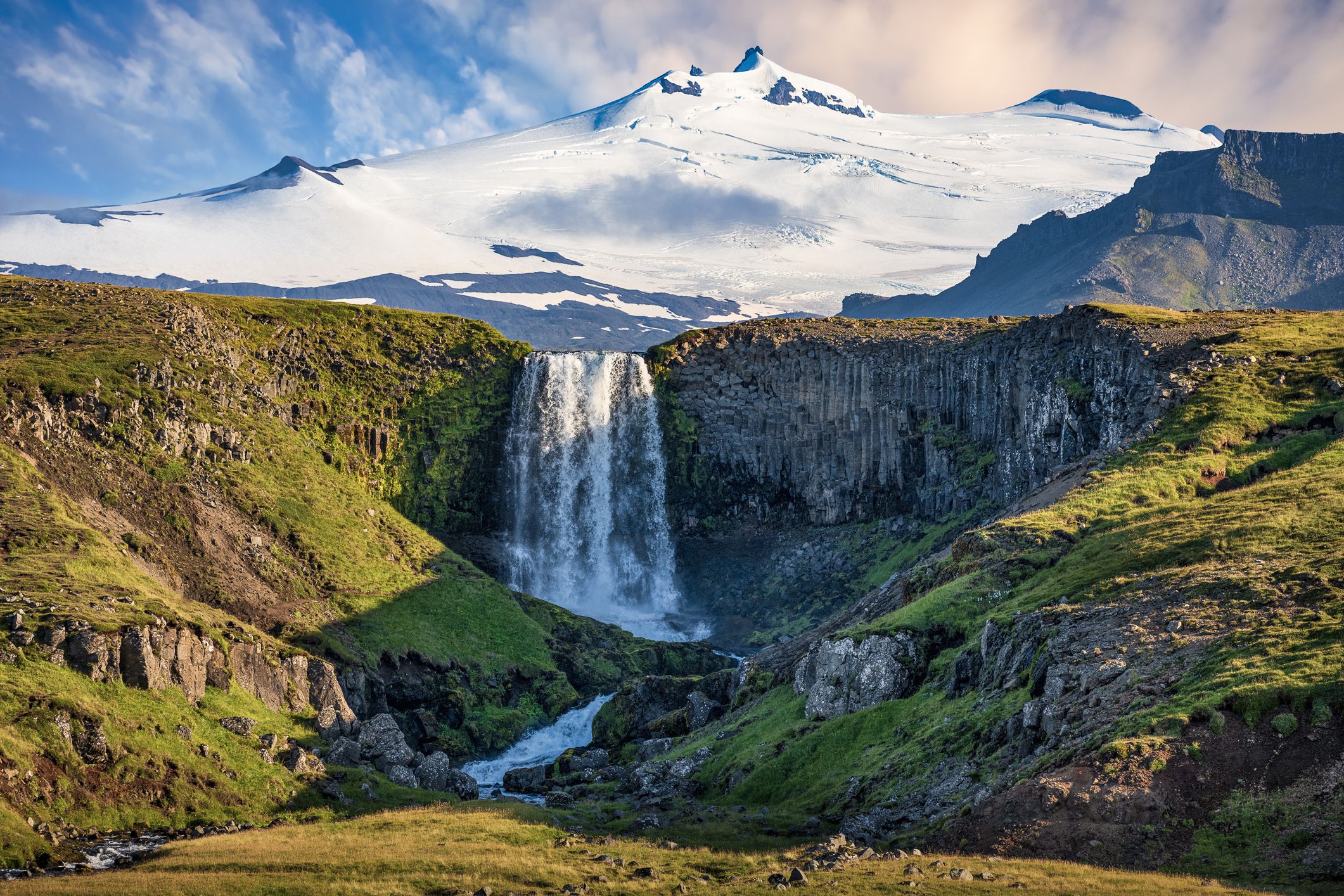
Snæfellsjökull, Iceland
Eldritch Mountains
An excellent example of an incarcerated mountain world is Alan Baxter’s 2015 short story ‘In Vaulted Halls Entombed’ and its adaptation in Netflix’s anthology series Love, Death + Robots. The plot goes that a troop of US marines chase their target into a mountain only to discover a vast hall which acts as the prison for what Baxter calls an “incredibly powerful cosmic elder god of some kind” (2022). Although the Netflix adaptation showed the entity to the audience and characters (an interview clarifies that the adaptors blended Baxter and Lovecraft by choosing to depict the cosmic elder god as the latter’s Cthulhu), Baxter notes that in his story only Coulthard sees the god: “the reader doesn’t and it’s ambiguous about whether or not the ‘survivor’ saw it” (2022). This distinguishes Baxter’s story from the genre, playing with the reader’s expectations to the degree that we question the ontology of the eldritch entity: is it simply a phenomenological experience? Is it a being that only penetrates and exists inside the mind? Recalling Shepherd, knowledge only intensifies mystery.
Cthulhu as depicted in Netflix’s Love, Death + Robots S3E8: ‘In Vaulted Halls Entombed’ (2022).

Although Baxter presents the story as “original” and not Lovecraftian (2022), the use of a mountain interior as the dwelling place of eldritch terrors is a Lovecraftian device that was employed in H.P. Lovecraft’s short story ‘At the Mountains of Madness’ (1936) and, an example that came to mind while writing the paper, the Doctor Who episode ‘The Satan Pit’ (2006). In Lovecraft’s narrative, a team of scientists discover and learn about an abandoned civilisation inside a mountain range in Antarctica. As they examine the city ruins they learn about the conflicts between incalculably ancient races. One character even speculates that this is the place where all life on earth originated:
He was strangely convinced that the marking was the print of some bulky, unknown, and radically unclassifiable organism of considerably advanced evolution, notwithstanding that the rock which bore it was of so vastly ancient a date – Cambrian if not actually preCambrian – as to preclude the probable existence not only of all highly evolved life, but of any life at all above the unicellular or at most the trilobite stage. These fragments, with their odd marking, must have been five hundred million to a thousand million years old. (1936)
Just as Baxter indicates that eldritch beings are still alive in the twenty-first century, so does Lovecraft with the reveal of depiction of a shoggoth as a “nightmare, plastic column of fetid black iridescence” (1936). Likewise, both writers conclude their narratives with humans speaking in the languages of their fictional eldritch gods:

From ‘In Vaulted Halls Entombed’ (Gelatt 2022)
At the time, his shrieks were confined to the repetition of a single, mad word of all too obvious source: “Tekeli-li! Tekeli-li!” (1936)
These narrative choices imply that mountain worlds can spill over and impact the human world. There are broader questions to be asked about how this specific narratological device plays with the intersectionality of colonialism, military occupation, ecology, capitalism, posthumanism, and patriarchy. Established social hierarchies are brought into question, upturned, and threatened by stories such as Baxter’s and Lovecraft’s as human taxonomies and conceptual frameworks fail to categorise let alone comprehend ancient orders and beings depicted in these narratives. It is not a coincidence that these stories commonly end with the human narrator becoming mad as their cosmos and world views are shattered by the mere existence of these beings.
Keeping the Torch Burning
This blurring of the lines between human and mountain worlds is further explored in R.F. Kuang’s The Poppy War trilogy (2018-2020). In the first novel Jiang forebodes that “The Seal is breaking. I can feel it—it’s almost gone. If I leave this mountain, all sorts of terrible things will come into your world” (2018). Kuang experiments with Fantasy’s tradition of imprisoning characters or entire peoples within mountains through the instrumentalisation of the incarcerated shamans in Chuluu Korikh. Rin, Altan, and Jiang engage in an ethical debate whether to wake the thousands of imprisoned shamans or not. Repeatedly, Rin and Altan reduce the shamans to an “army” that they can “control” and “command” (2018). Jiang rebukes this way of thinking as “These are not men entombed in this mountain; these are gods. They will treat the material world as a plaything. They will shape nature according to their will. They will level mountains and redraw rivers” (2018). When pressed, Jiang further exposes the futility of Altan’s vengeful patriotism:
“I want to save Nikan,” Altan insisted. […]
“No, you don’t,” said Jiang. “You want to raze Mugen.”
“They’re the same thing!”
“There is a world of difference between them, and the fact that you don’t see that is why you can’t do this. Your patriotism is a farce. You dress up your crusade with moral arguments, when in truth you would let millions die if it means you get your so-called justice. That’s what will happen if you open the Chuluu Korikh, you know […] It won’t be just Mugen that pays to sate your need for retribution, but anyone unlucky enough to be caught in this storm of insanity. Chaos does not discriminate […] and that’s why this prison was designed to never be unlocked.” (2018)
The release of the shamans will have apocalyptic consequences. Much like Baxter’s god and the Beast in Doctor Who’s ‘The Satan Pit’, the shamans are removed from society to protect the status quo as their release into the human world will lead to its collapse. I propose that while the texts I’ve discussed in this blog post have expanded the cosmic playing field, they appear to keep one foot rooted in the entrenched xenophobia and racial binaries of British colonialism as they were explored in fin de siècle Gothic texts. Examples of this include Strange Case of Dr Jekyll and Mr Hyde (1886) where Hyde is described as anything but English and Dracula (1897) where a life-draining being from the East threatens London, the capital of the waning British empire. In these texts outsiders and perceived threats are best kept in the dark, forgotten and silenced so that they do not upset or disturb the ordered human world. There’s more room to speak about this but that could be a whole blog post in itself and this is only the beginning of my research into Fantasy mountains!
Baxter, Lovecraft, and Kuang conceive of mountains as spaces where the acquisition of knowledge only intensifies mystery, prompting questions whose answers are either incomprehensible to human minds or simply unattainable. The revelations and discoveries made by explorers reinforce humanity’s diminutive status and the fragility of our social order. Exposure to these worlds and the beings that inhabit them are frequently framed as monstrous and potentially contagious; they are expelled from society and locked away to protect the status quo. They are to be forgotten and left to dwell in the dark. That is, until the drill cracks their cage.
Bibliography
Baxter, Alan. 2015. ‘In Vaulted Halls Entombed’ in SNAFU: Survival of the Fittest, ed. by Geoff Brown and A J Spedding (Beechworth: Cohesion Press), pp. NA. Kindle edition.
— 2022. Love, Death + Robots S3, featuring ME! Available at: https://alanbaxter.com.au/love-death-robots-s3-featuring-me/
Gelatt, Philip. 2022. ‘In Vaulted Halls Entombed’ dir. Jerome Chen, Love, Death + Robots S3E8 (Netflix).
Kuang, R.F. 2018. The Poppy War (Glasgow: Harper Voyager). Kindle edition.
Lovecraft, H.P.. 1936. ‘At the Mountains of Madness’, Astounding Stories, Volumes 16.6, 17.1, 17.2. Kindle edition.
Shepherd, Nan. 2014. The Living Mountain (Edinburgh: Canongate).


 Will Sherwood
Leave a comment