
This year’s re-read of The Lord of the Rings has led to some striking revelations. Many are intimately linked to British Romanticism and how Tolkien grapples with its ideas and legacies (some problematic) that continue to live on today. For more on this, see my blog post on Romantic legacies. But this post isn’t about my PhD thesis – sorry – or at least, what is not currently a part of the thesis… Rather, I want to take some time to root through an epiphany that is partially driven by reading Suzanne Simard’s Finding the Mother Tree: Uncovering the Wisdom and Intelligence of the Forest (2021), Journee Cotton’s PhD thesis Reading the Corpus: Environmental Bioethics in Middle-earth (2024), mine and Journee’s work on our Oxonmoot paper ‘Arda Marred and Climate Change: Ecological Anxiety and the End of the World’ (2024) (and yes, we’re working on this for publication), and an ongoing, deep, rich conversation with a dear friend.
In this post I will examine how the Old Forest, Lothlórien, and Fangorn Forest can be read the lens of Simard’s work on Mother/Father Trees. Specifically, it will examine how Old Man Willow, the greatest of the mallorns, and Treebeard epitomise the Mother/Father Tree model. The work is, like most of what I write and post on my blog, ongoing and new(ish). I also need to acknowledge Journee’s influence here as she introduced me to Simard.
So let’s begin with some definitions.
What are Mother/Father Trees?
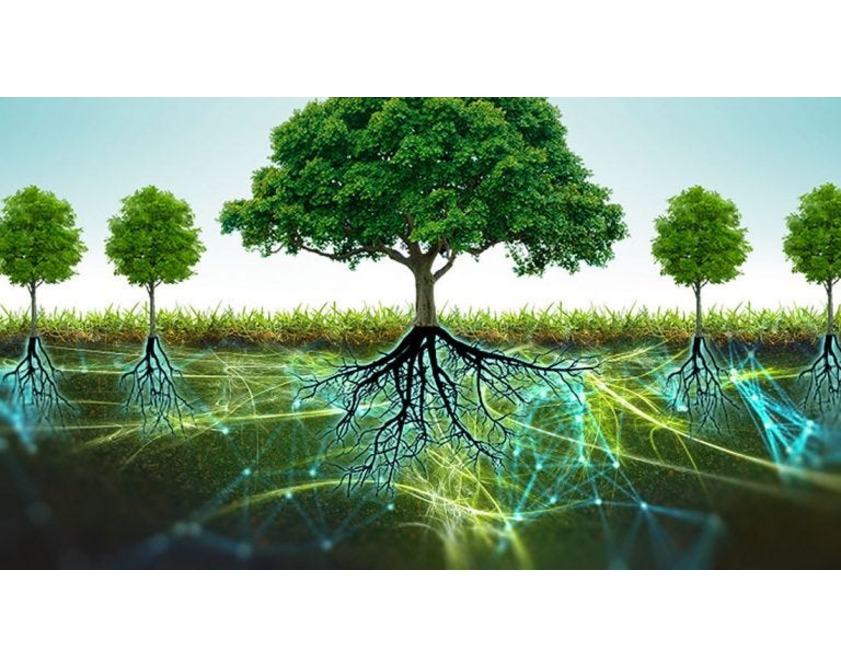
Simard’s work revolves around the central argument that forests are collaborators as well as competitors, rather than just the latter as was traditionally believed in the later half of the twentieth century (Simard 2021: 305). Linking each tree is a “cryptic underground fungal network” of mycorrhizal that is “pervasive through the entire forest floor, connecting all the trees in a constellation of tree hubs and fungal links” (5; emphasis original). Calling the network a “constellation” conjures a dazzling image of the earth as a vast, deep, complex body in which the trees’ roots interlace and interact.
At the heart of this model are the Mother/Father Trees: “majestic hubs at the center of forest communication, protection, and sentience” who can “discern which seedlings are their own kin” (5). They are, to use Tolkienian terms, Eldest and Oldest, the caretakers of the forests. When Mother/Father Trees die, they even “pass their wisdom to their kin, generation after generation, sharing the knowledge of what helps and what harms” (5). After just reading back through this quick summary it’s almost impossible not to think of Tolkien’s woods and forests! Simard and Tolkien share a mutual anxiety over the extreme practices of deforestation and this is the connection that underpins why Simard’s work is relevant to how we can think about Middle-earth’s trees.
If you’re interested in learning more about Simard’s work and background then you can read her book or watch her concise and insightful TED Talk ‘How trees talk to each other’. If you prefer visual examples then I recommend ‘The Secret Language of Trees‘ which follows Simard’s work.
A Single Forest
I should start by noting that I will not be talking about Mirkwood from The Hobbit. As it’s from a different novel that was written in a different context to The Lord of the Rings, the forest has a completely different character to the woods and forests in its sequel novel. It may feature in some later post.
Here, then, I’m concerned with the Old Forest that borders the Shire, Lothlórien, and Fangorn Forest. It’s worth stressing that these (along with Mirkwood) were once part of what I’m calling Middle-earth’s primordial arboreal network. Long ago, way before the First Age, a single forest ran from Ered Luin (far-left) to Mirkwood (far-right) and would have roughly covered the space inside the red line on the map.

Tom Bombadil, Elrond, Treebeard, all of whom are ancient and have long memories, recall the ancient forest at various moments in the text. Bombadil tells the Hobbits that the Old Forest is a “survivor of vast forgotten woods”, Elrond mourns that “Time was when a squirrel could go from tree to tree from what is now the Shire to Dunland”, Treebeard recalls that “there was all one wood once upon a time from [Fangorn] to the Mountains of Lune”, and, according to Unfinished Tales, Lothlórien once “extended far […] into more open woodland of smaller trees that merged into Fangorn Forest” (Tolkien 2007: 130, 265, 468; 1998: 338).
By the end of the Second Age, following significant deforestation at the hands of the Númenóreans and the wars of the Elves and Sauron, the Old Forest, Lothlórien, and Fangorn Forest were reduced to fragmentary relics of what was once a single vast forest, the primordial arboreal network of Middle-earth. Tolkien and Treebeard share a deep compassion for the Old Forest, where “bad memories” of past abuse are “handed down” (Tolkien 2007: 468; emphasis mine; Letter 339). Tolkien’s language here pre-empts Simard’s own. But by reading The Lord of the Rings through the lens of Simard’s work, Tolkien’s personification is pulled into question as information and memory is literally, not figuratively, transferred from one generation to the next.
It’s worth dwelling a little on Treebeard’s dialogue as he further informs Merry and Pippin that there are places in Middle-earth where the “trees are older than I am” (468). Recall that the Ents are younger than the trees as they were created afterwards. Contrast this with Gandalf the White’s remarks that by the end of the Third Age Treebeard is the “oldest of the Ents, the oldest living thing that still walks beneath the Sun upon this Middle-earth” (499; emphasis mine). Besides complicating Bombadil’s claim to the translingual title ‘Eldest’, the trees in the Old Forest are posited as the ‘eldest’ of the trees in Middle-earth. This neatly links to Bombadil’s own recollection of the Old Forest as the home of the “fathers of the fathers of trees” (130). But amongst the trees of the Old Forest sits “the Great Willow” (130).
Tolkien’s Mother/Father Trees 1/3: Old Man Willow
Old Man Willow (OMW) is the Father Tree of the Old Forest. Bombadil’s free indirect discourse (part of the narrative that blends speech with thought and feelings, a technique favoured and popularised by Jane Austen) says as much:
none were more dangerous [in the Old Forest] than the Great Willow: his heart was rotten, but his strength was green; and he was cunning, and a master of winds, and his song and thought ran through the woods on both sides of the river. His grey thirsty spirit drew power out of the earth and spread like fine root-threads in the ground, and invisible twig-fingers in the air, till it had under its dominion nearly all the trees of the Forest from the Hedge to the Downs. (130; emphasis mine)
Although OMW is coded as evil (e.g. “rotten” heart, “cunning”) – and you could interpret the Forest as subjects to OMW’s manipulative will, there is room to consider how his control over the Old Forest may have been a traumatic response to several millennia of hostility from humanoid beings. The Old Forest appears to have entered a sort of survival mode, treating anything that enters as hostile. OMW’s superimposed spiritual governance is made possible through what Simard describes as the “constellation of tree hubs and fungal links” in the earth but also, because this is Middle-earth and the world was created through music, through his song. Newer trees will have received OMW’s traumatic, “bad memories” of war and abuse. It is little surprise, then, that the four Hobbits are treated antagonistically by the defensive trees that create a stifling, claustrophobic atmosphere. The Hobbits are steered by the forest to OMW, who attempts to lull them to sleep and murder them. The external threat is literally dealt with by the arboreal alpha. That is, until Bombadil comes along.
Tolkien’s Mother/Father Trees 2/3: Caras Galadhon
Unlike the self-sufficient Old Forest, Lothlórien’s Mother/Father Tree has a more complicated life as it and the forest are framed by the Elves as reliant on one of the Rings of Power. The central mallorn is depicted as the
mightiest of all the trees: its great smooth bole gleamed like grey silk, and up it towered, until its first branches, far above, opened their huge limbs under shadowy clouds of leaves. (354)
It is shortly afterwards called “the great mallorn” and this tree is, perhaps unsurprisingly given Tolkien’s use of hierarchies, the home of Galadriel and Celeborn (354). The Mother/Father Tree of Lothlórien is entangled with the power of Nenya, positing them, as it appears to Frodo, as the combined source of the forest’s vitality: “Out of [Caras Galadhon], it seemed to [Frodo] that the power and light came that held all the land in sway” (351; emphasis mine). This raises questions about humanoid stewardship that employs technological intervention to control the organic rhythms and processes of the earth. What would have happened to the mallorn trees had Nenya not interfered? Samwise’s planting of the seed after the scouring of the Shire indicates that the forest could have survived without the Elves embalming the land.
But I’m digressing – albeit a useful and important digression. Like OMW’s command over the Old Forest, the great mallorn from which Nenya operates is described as holding the land in “sway”. According to its definition in the Oxford English Dictionary (OED), “sway” suggests that the central mallorn “commands”, “controls”, and “directs” the forest:

So Lothlórien does have a Mother/Father Tree. But unlike OMW and the Old Forest, this is in affiliation with Nenya, the result of industrial and artistic practice, rather than a sentient being that slowly spreads its will across the forest. The relationship between the Mother/Father Tree and Nenya perhaps hints that the Ring harnesses the fungal network in the earth to control the land. (I use “perhaps” and “hints” heavily here as this is certainly conjecture and an early exploration into this material!) The Elves’ reliance on conservation keeps the Mother/Father Tree and the forest alive, but the cost, according to the Elves that live in the forest, is that once Nenya’s power is removed the Mother/Father Tree will die (Tolkien prefers the word “fade”). By delaying death, is this really any better than deforestation? Is it perhaps a form of deforestation slowed down dramatically and drawn out? If so, there are conversations to be had about this area of Tolkien’s work and Rob Nixon’s concept of “slow violence” (2011: 2). Are the Elves really doing any justice to the land or the trees? Food for thought.
Tolkien’s Mother/Father Trees 3/3: Treebeard
As I noted above, Gandalf suggests that Treebeard is the “oldest living thing that still walks beneath the Sun upon this Middle-earth”. There are two points that I want to address here: 1) how Tolkien implies that Treebeard is the progenitor of the remnants of Fangorn Forest, and 2) Treebeard’s position as the Father Tree of Fangorn Forest.
The first point came to me while I was reading about the Entmoot. Merry and Pippin observe that the Ents
gathered around Treebeard, bowing their heads slightly, murmuring in their slow musical voices, and looking long and intently at the strangers, then the hobbits saw that they were all of the same kindred, and all had the same eyes: not all so old or so deep as Treebeard’s, but all with the same slow, steady, thoughtful expression, and the same green flicker. (480; emphasis mine)
Looking again to the OED, “kindred” means a

All the Ents have the “same eyes” as Treebeard and house the “same green flicker”, indicating that Treebeard is their genetic forefather. The proximity of this revelation to the Ents “gathering” and “bowing” around Treebeard further hints at a reverence they hold for him as their ancestor. It is also Treebeard that calls and leads the Entmoot, suggesting the power he holds over his descendants.
The second point was prompted by another line of Gandalf’s dialogue: “But now his long wrath is brimming over, and all the forest is filled with it. […] it will soon be running like a flood” (500; emphasis mine). Gandalf suggests that Treebeard’s emotions can be transmitted across the entire forest, much like how Mother/Father Trees can send out warnings and signals of distress to their children. Here the Ents, Huorns, and trees may have been awoken by Treebeard tapping into the deep fungal network (forget Treebeard’s roar in the 2002 film!) that interlinks the matrix of roots. The hubs and networks would allow him to send signals, memories, and intense emotions across Fangorn, rallying the forest to the Entmoot and siege of Isengard. This would explain Pippin’s speculative question at the climax of the chapter ‘Treebeard’: “Could it be that the trees of Fangorn were awake, and the forest was rising, marching over the hills to war?” (487).
Like OMW and the great mallorn, Treebeard is able to affect the forest community he belongs to. It’s worth noting as well that Treebeard’s Elven name is Fangorn: was he named after the forest or did the forest take on his name? I’m not sure if we have an answer to this – please point to it in a comment if you know where Tolkien answers this! But unlike OMW and the great mallorn, Treebeard now seems to utilise the resources available to him as the Father Tree to reinvigorate the forest.
Summing Up
This blog post has been an exploratory discussion about how a fantasy novel from the 1930s-1950s pre-empted Anglo academy research from the end of the twentieth century. It’s uncovered how three woodland areas, once connected as one, vast primordial arboreal network, come to rely on the Mother/Father Tree model for protection and life. Each example explores the model to differing degrees, raising questions over the values, complexities, and problems that the model can present and how humanoids interest and understand forest networks. OMW can be framed as a villain, but when looked at through a traumatic lens, he suddenly becomes a fiercely protective Father over the forest and the Hobbits are a hostile threat that need dealing with before the wood is injured any further. It’s not possible to determine the extent to which the mallorns are reliant on Nenya or the long-term damage wielding Nenya will have on the land’s ecosystems, but the effects are at the very least unnatural. As for Treebeard, his linguistic and genetic relationship with Fangorn may initially situate him as a foil to OMW, but when their motivations and aggressive retaliation to anyone wanting to harm their community are compared, they become strikingly similar.
There is more work to be done on this (look forward to mine and Journee’s article), but hopefully this has prompted some thought on how Tolkien’s forests operate in relation to recent developments in arboreal research.
Bibliography
Nixon, Rob. 2011. Slow Violence and the Environmentalism of the Poor (Cambridge: Harvard University Press).
Simard, Suzanne. 2021. Finding the Mother Tree: Uncovering the Wisdom and Intelligence of the Forest (Dublin: Penguin Books).
Tolkien, J.R.R. 1998. Unfinished Tales of Númenor and Middle-earth, ed. by Christopher Tolkien (London: HarperCollins).
— 2007. The Lord of the Rings (London: HarperCollins).
— 2023. The Letters of J.R.R. Tolkien: Revised and Expanded Edition, ed. by Humphrey Carpenter with the assistance of Christopher Tolkien (London: HarperCollins).


 Will Sherwood
Leave a reply to judddanby Cancel reply